

Breed profile
Golden Retriever
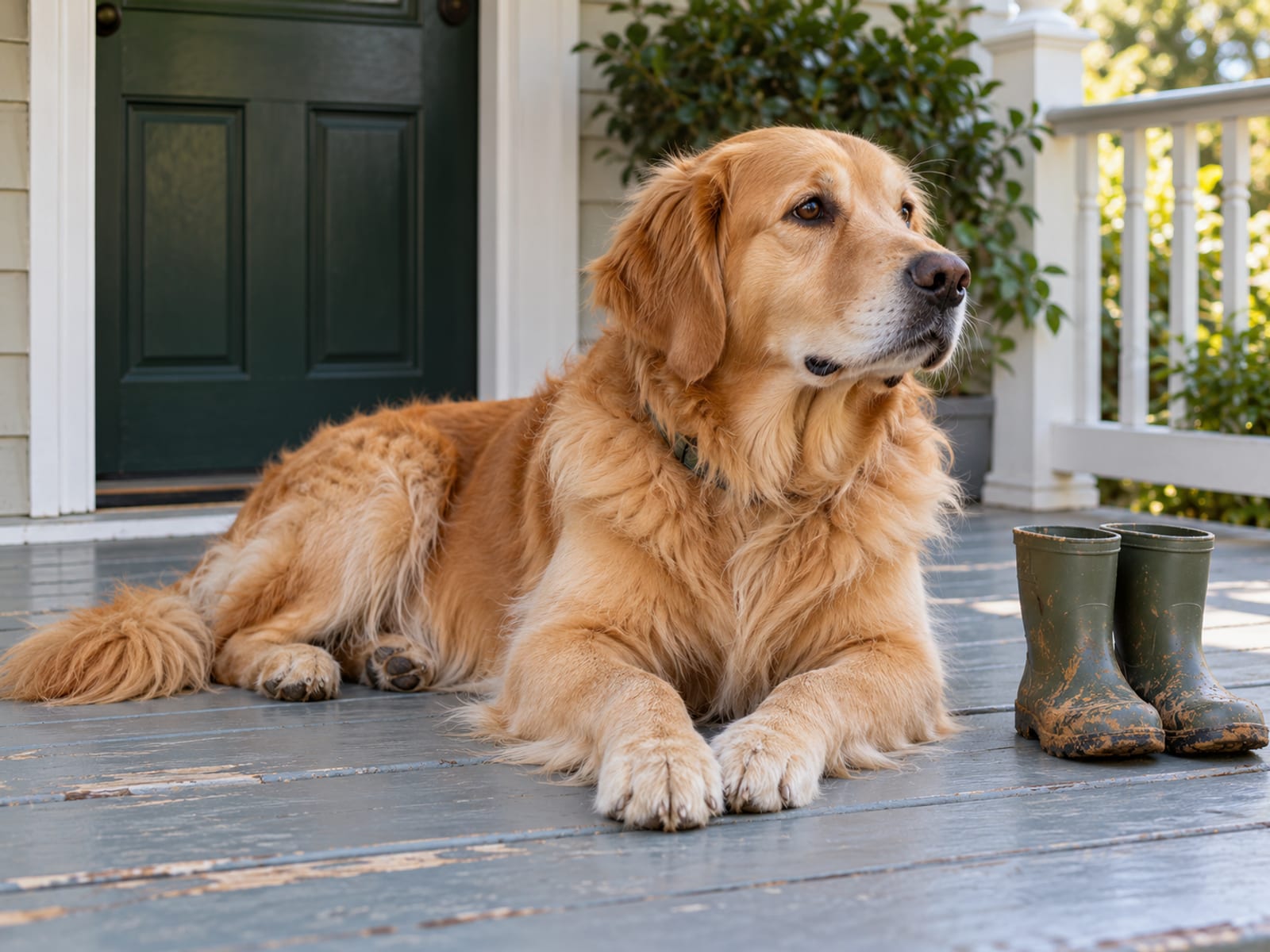
A large, social, active dog that sheds heavily and wants to be involved in daily life.
Adult size
Males
- Weight
- 65 to 75 lb (29.5 to 34 kg)
- Height
- 23 to 24 in (58 to 61 cm)
- Size group
- Large
Females
- Weight
- 55 to 65 lb (24.9 to 29.5 kg)
- Height
- 21.5 to 22.5 in (55 to 57 cm)
- Size group
- Large
Source: AKC breed page. Puppy size guide
AKC ratings (1 to 5)
These are the American Kennel Club's ratings for the breed as a whole; each dog is an individual. Source: AKC breed page (2026-10-23).
Living with a Golden Retriever means sharing your home with a large, social, active dog that sheds heavily and wants daily involvement. Goldens often learn readily and enjoy walks, retrieving, swimming and training, but they still need time, companionship, grooming and a health budget.
The AKC standard puts adult males at 23 to 24 inches and 65 to 75 pounds, and females a little smaller. That is a big dog on the couch, in the car and at the end of a leash.
These are tendencies, not guarantees. The individual dog and the match with your household matter more than any breed description, and the sections below cover what to plan for. Goldens are also sometimes called cobrador dorado in Spanish.
What a normal day looks like
A Golden Retriever was developed in Scotland as a hunting retriever that brought back shot waterfowl and upland game, including from water. Many still carry that love of fetching and swimming, and modern Goldens also work as guide dogs and in search and rescue.
At home, that usually means a dog who follows you from room to room and wants to be part of whatever is going on. Plan for exercise, a bit of training, and time just being near you.
How much exercise a Golden needs
For a healthy adult, plan on roughly 60 to 120 minutes of combined activity a day, adjusted for age, health, weather and the dog. The Golden Retriever Club of America (GRCA) says Goldens need regular exercise and are not self-exercisers, so a fenced yard does not replace walking, playing or training with you.
Good outlets include brisk walks, swimming, retrieving, hiking, tracking, obedience, agility and scent games. Mental work counts too; the AKC rates the breed 4 out of 5 for mental stimulation needs.
Puppies and teenagers have plenty of energy, but go easy on repetitive high-impact exercise. The GRCA advises against jogging and biking for young Goldens until at least 12 months of age, and suggests asking your veterinarian before strenuous activity.
Grooming and shedding
The coat is a dense, water-repellent double coat, straight or wavy, with moderate feathering. Goldens shed some all year and much more once or twice a year, and the AKC rates shedding 4 out of 5. Expect hair on clothes, floors and furniture.
A practical routine looks like this:
- Brush once or twice a week most of the year, and daily during heavy shedding.
- Plan about 15 to 30 minutes per regular session, longer in a heavy shed.
- Bathe when the dog is dirty, and dry the coat fully before brushing.
- Check ears weekly and keep them clean and dry.
- Trim nails regularly and brush teeth often.
Routine clipping is not required, and it should not change the natural outline. A professional groomer can help with bathing, drying and paw trimming if you would rather hand that off. If allergies are a concern, know that the AAAAI states there are no truly hypoallergenic dog breeds.
Temperament, training and time alone
The AKC standard calls the breed "friendly, reliable, and trustworthy," and the AKC describes Goldens as outgoing, loyal, eager to please and very easy to train. Those are breed tendencies. Early socialization, humane training and each dog's history still shape the adult.
Goldens are relatively quiet, and the AKC rates barking level 1 out of 5, though some bark when they notice activity outside. They are not typically suited to watchdog work.
Time alone is where many Goldens struggle. The GRCA says isolation can lead to boredom, stress, barking, chewing, digging and hyperactivity. Very young puppies should not be left alone for more than a half day without a dog walker or daycare, and an adult's tolerance depends on the dog and its training.
Fit with kids, pets, visitors and apartments
Goldens tend to be friendly with familiar people, visitors and other dogs, and the AKC rates the breed 5 out of 5 for young children and for other dogs. The AKC also says dogs should always be supervised around children and during introductions to other dogs. A friendly breed does not guarantee safe behavior with every child, visitor or pet.
Cats and other small pets need individual assessment, slow introductions and supervision.
Apartment living can work when the dog gets enough daily exercise, training and company. Square footage does not remove the breed's activity needs.
This breed tends not to suit a household that wants a low-shedding dog, a sedentary dog, a dog kept outdoors, or a dog that will regularly spend long hours alone. If you are comparing it with other family-friendly options, our list of 9 family-friendly dog breeds is a good place to compare.
Health: what to know and what to ask about
Cancer is a major concern in Goldens, including mast cell tumors, melanoma, hemangiosarcoma and lymphoma. In a 1998 GRCA survey of 1,444 dogs aged 5 or older, 43.7% had a reported cancer diagnosis, though that sample leaned toward older dogs. The Morris Animal Foundation's Golden Retriever Lifetime Study follows the breed's health over time.
Other breed-linked conditions include hip and elbow dysplasia (joint development problems that can cause stiffness, lameness and arthritis), hereditary eye disease, subvalvular aortic stenosis (an inherited heart narrowing), hypothyroidism, epilepsy, skin allergies and ear infections.
These are population-level risks, not a diagnosis for any one dog. Screening of parent dogs lowers some inherited risks but does not remove every condition, especially cancer, epilepsy, hypothyroidism and many skin diseases. For life span, the AKC lists 10 to 12 years; a 2024 UK study of 11,506 Goldens reported a median of 13.2 years, which is not a US figure or a promise.
What a Golden costs
Prices vary a lot, so treat these as dated reference points.
- Breeder puppies: Good Dog listed roughly $2,000 to $3,500 as of October 2026. That is a marketplace range and says nothing about breeding quality.
- Rescue: Golden Retriever Rescue of Atlanta lists 2026 fees of $1,200 for puppies under 1 year, $900 for ages 1 to 4, $700 for ages 5 to 7 and $400 for ages 8 and up.
- Yearly care: the AKC's 2004 owner survey averaged $2,489 a year across food, vet care, grooming, boarding, toys, training and events. It is old and not specific to Goldens.
- Insurance: a 2026 Kiplinger report citing NAPHIA gave an average accident-and-illness premium of $56.30 a month, about $676 a year, varying by age, location and coverage.
Food, grooming, vet care and emergencies vary by where you live and by the dog. Price local food, grooming and insurance quotes before you settle on a yearly number.
Questions to ask a breeder, rescue or foster
For a breeder, start with health testing. The GRCA and the OFA's CHIC program call for hip and elbow evaluations, a yearly eye exam by a veterinary eye specialist, a heart exam at 12 months or older, and permanent identification. The AKC's breed-club list also includes a DNA test for NCL5.
A CHIC number means the required tests were done and the results made public. It does not mean every result was normal. Ask for the registered names or OFA numbers of both parents, look up the public records, and request current eye and heart clearances plus hip and elbow results. The GRCA health-screening page lays out the details.
For a rescue or foster, ask for all available veterinary records, known diagnoses and treatment history. Also ask how the dog behaves with children, cats and other dogs, and how long it can comfortably stay alone. Fencing rules, fees and geographic limits differ by organization.
Where to go next
If you are leaning toward adoption, the GRCA's CARE network lists affiliated Golden Retriever rescues across the United States. The AKC Rescue Network and local shelters are other routes, and the dogs may be purebred or mixes.
To see how big a puppy is likely to get, try the puppy size guide. To compare Goldens with other breeds, browse the dog breeds hub. Our list of 5 best dog breeds for first-time owners shows where Goldens sit for a first dog, and the 9 family-friendly dog breeds list covers households with kids.