

Breed profile
Labrador Retriever
A friendly, strong, energetic dog that wants to be part of whatever the family is doing.
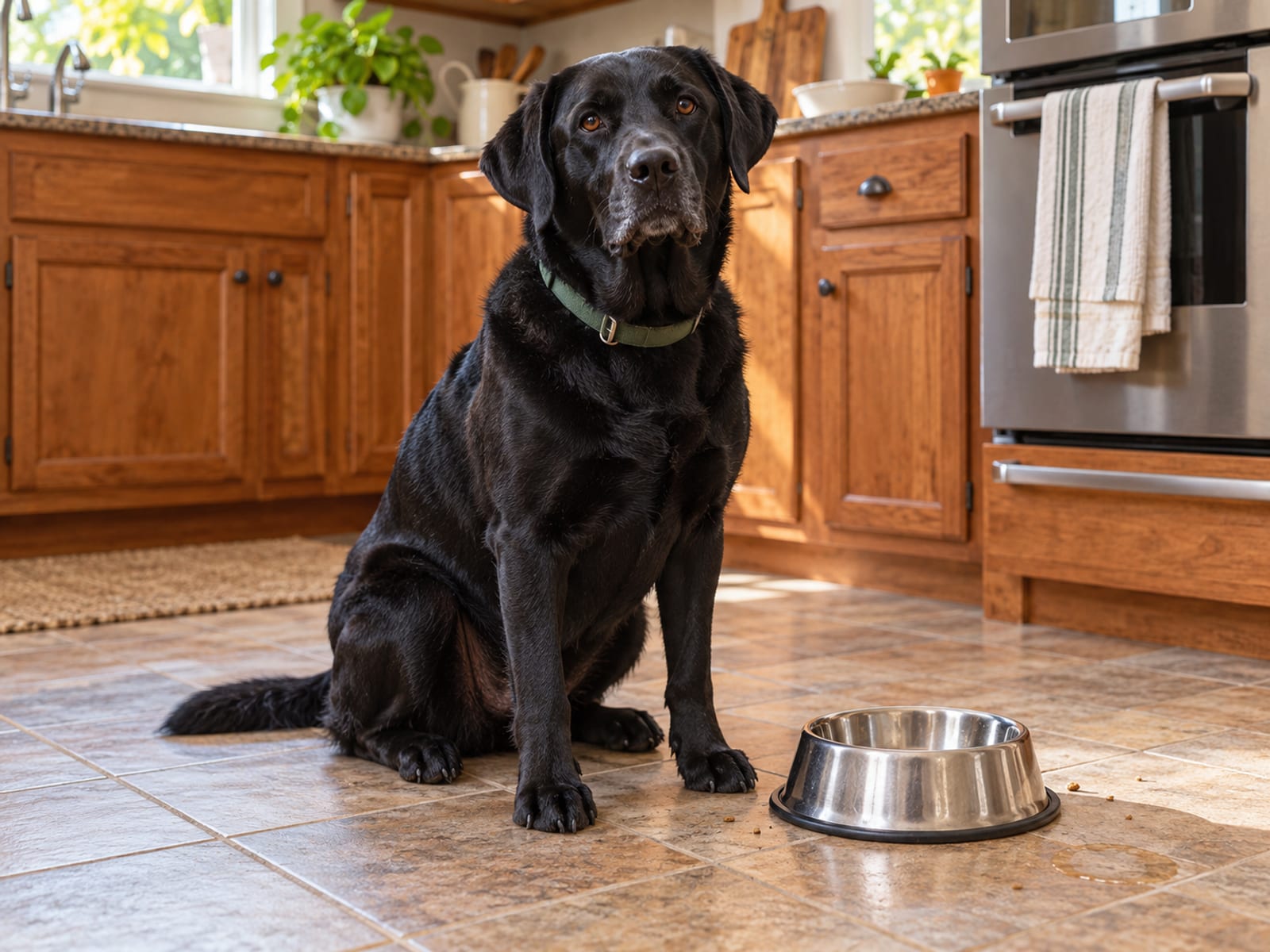
Adult size
Males
- Weight
- 65 to 80 lb (29.5 to 36.3 kg)
- Height
- 22.5 to 24.5 in (57 to 62 cm)
- Size group
- Large
Females
- Weight
- 55 to 70 lb (24.9 to 31.8 kg)
- Height
- 21.5 to 23.5 in (55 to 60 cm)
- Size group
- Large
Source: AKC Labrador Retriever standard; AKC breed page. Puppy size guide
AKC ratings (1 to 5)
These are the American Kennel Club's ratings for the breed as a whole; each dog is an individual. Source: AKC breed page (2026-10-23).
A Labrador Retriever is a friendly, strong, energetic dog that usually wants to be part of whatever the family is doing. Expect daily exercise, steady training, regular shedding and careful attention to weight. Labs can do well in an active apartment or house, and they are a poor match for a household that wants a quiet, low-maintenance dog.
The breed was developed from water dogs associated with Newfoundland fishermen, then refined by English sportsmen in Great Britain. The work was retrieving fish, waterfowl and upland game, often from cold water. Today Labradors also work in assistance, detection, search and rescue, hunting and dog sports, and that history explains a lot about the dog on your couch.
Adults generally run about 55 to 80 pounds, so this is a big dog with a big wag. The AKC puts the breed in the Sporting Group and lists a life expectancy of 11 to 13 years.
How much exercise does a Lab need every day?
The AKC calls the Labrador Retriever "an exuberant, very energetic breed that needs lots of exercise every day." A workable plan for an adult is about 60 minutes or more of physical activity, split across walks, fetch, swimming, hiking or active play. Treat that number as a planning guideline, not a rule written into the breed standard. Dogs from working lines may need more structure than others.
Add short bursts of mental work too, such as training sessions, scent games or food puzzles. The AKC names retrieving, swimming, hunting, field trials, agility, obedience, tracking and dock diving as good outlets. A Lab that gets too little of any of it can gain weight, turn hyperactive, or start chewing things you care about.
Puppies need age-appropriate activity. Avoid repetitive high-impact exercise while they are still growing, and adjust for any dog's age, condition and your veterinarian's advice, since hip and elbow disease are known concerns for the breed.
What does grooming and shedding really take?
The coat is short, dense and weather-resistant over a thick undercoat, so there is no clipping and no standing salon appointment. What you do get is hair. Labradors shed all year, and the AKC says they can shed "in handfuls" twice a year, usually in spring and fall. The AKC's trait scale rates shedding at 4 out of 5 and coat grooming frequency at 2 out of 5.
A typical routine looks like this:
- Brush about once a week, and daily during heavy shedding.
- Bathe occasionally; the AKC gives every four to six weeks as an example for indoor dogs, with extra baths after mud or swimming.
- Trim nails about every three to four weeks.
- Brush teeth often or follow your veterinarian's dental plan.
- Check and clean the ears, especially after swimming, because floppy ears hold moisture.
Home sessions usually take a few minutes each. If allergies are a concern, the American College of Allergy, Asthma and Immunology says no dog breed is truly free of allergens, and a Lab is not a lower-shedding choice.
What is a Lab's temperament and training like?
The Labrador Retriever Club describes the ideal disposition as "kindly, outgoing, tractable," "eager to please" and "non-aggressive towards man or animal." The AKC adds friendly, high-spirited, devoted and intelligent. Those are breed tendencies, and each dog still arrives with its own personality.
Labs generally respond well to reward-based training, and the AKC rates trainability 5 out of 5. The same food motivation, retrieving drive and energy can also produce jumping, mouthing, counter-surfing and chewing if those habits get rewarded by accident. Because of the breed's strength, the AKC recommends early socialization and puppy training classes.
Barking sits in the middle, at 3 out of 5 on the AKC scale. Labs are people-oriented and like to join in, so time alone should be built up gradually, and a full workday alone is not something to assume for any individual dog.
Do Labs fit kids, other pets, visitors and apartments?
The AKC rates the breed 5 out of 5 for young children, other dogs and openness to strangers, and describes Labs as companionable housemates that bond with the whole family. Those are AKC's ratings of breed tendencies, and each Lab is an individual. Supervise children and dogs together, and introduce cats and visitors according to how the individual animals react. A young Lab is strong and enthusiastic, which matters around small kids.
An apartment can work when you reliably provide exercise, training, enrichment and chances to retrieve and play. A yard helps but does not replace walks or time with you.
The breed tends not to suit households that want a low-energy or low-shedding dog, cannot give daily activity, expect a dog to handle long stretches alone without preparation, or would struggle to manage an exuberant dog of 55 to 80 pounds.
Which health problems come up in Labradors?
Large UK veterinary studies point to a handful of concerns. The most common are joint problems such as hip dysplasia, elbow dysplasia, arthritis and cruciate ligament rupture, along with overweight, ear infections, skin trouble including hot spots, and eye disease. Cancer is also recorded as a significant category, and the AKC flags bloat as a potentially life-threatening condition in large, deep-chested dogs.
Two inherited conditions are specific to the breed: exercise-induced collapse, which can cause weakness or collapse after intense exercise in affected dogs, and centronuclear myopathy, a muscle disorder.
For scale, a 2018 VetCompass study of 2,074 UK Labradors recorded musculoskeletal disorders in 12.6%, ear disorders in 10.6%, skin disorders in 9.7% and overweight or obesity in 8.8%. Those are records from one UK population, not odds for your dog. Keeping a Lab lean is one of the most useful things you can do for its joints.
What costs should you plan for?
Puppy prices vary by region, bloodline and the breeder's health testing. A 2026 PuppyBase price guide reports roughly $1,500 to $4,000 from breeders it describes as reputable, with an average near $2,750. A 2025 breeder listing shows how individual prices land, and listings from 2025 and 2026 run from about $2,000 to $4,500. These are market examples, not a recommended price or a sign of quality.
Adoption usually costs less. The DFW Labrador Retriever Rescue charged $425 for puppies under six months, $350 for adults through age seven and $250 for seniors in 2025. Sunshine State Labrador Rescue lists $475, $400 and $225 for the same groups in 2026, plus a $25 application fee. Confirm current fees with any rescue.
For yearly care, an AKC survey of more than 1,000 website visitors put average annual dog costs near $2,500 for food, grooming, checkups, pet sitting and related care, according to the AKC cost of owning a dog. That is a general figure, and a 55 to 80 pound dog eats more than average. Training, boarding, insurance, dental work and emergency or orthopedic care add to it, so get local quotes.
What should you ask a breeder or rescue?
With a breeder, ask about health clearances for both parents. The Labrador Retriever Club lists hip and elbow evaluations through OFA, an eye exam by a board-certified veterinary ophthalmologist, and DNA tests for exercise-induced collapse and the D-locus dilute gene as minimum CHIC-related clearances. It also lists centronuclear myopathy, cardiac and prcd-PRA testing as additional or recommended. Ask for the parents' registered names and results, then verify them in the OFA public database. Details are on the club's health page.
With a rescue or foster, ask for all available veterinary records, behavior history, any bite history, how the dog has done with children and other animals, current medications, spay or neuter and microchip status, and the return policy.
For any Lab, ask how long it has been left alone and how it handled that.
Where to go next
The Labrador Retriever Club keeps a national rescue directory that lists Labrador rescues by state. The club notes that the directory is informational and does not endorse every group, so ask the questions above of each one.
To see how big a puppy is likely to get, try our puppy size predictor. Browse more profiles in the dog breeds hub. Labs also appear in two of our breed lists: 9 family-friendly dog breeds and 5 best dog breeds for first-time owners.