

Breed profile
Poodle
An active, highly trainable dog in three sizes that needs daily exercise, something to think about and regular grooming.
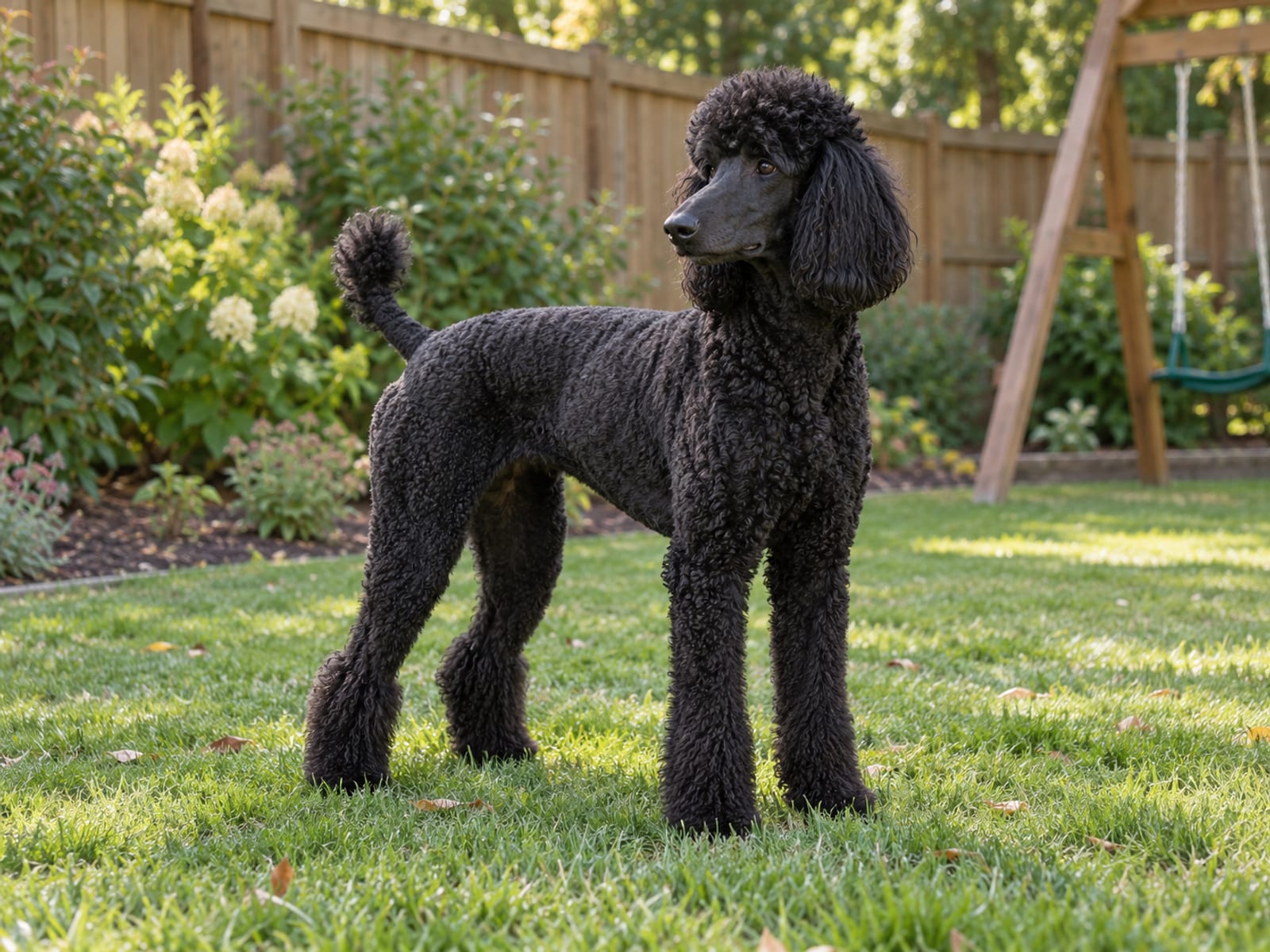
Adult size
Standard, males
- Weight
- 60 to 70 lb (27.2 to 31.8 kg)
- Height
- over 15 in (38 cm)
- Size group
- Large
Standard, females
- Weight
- 40 to 50 lb (18.1 to 22.7 kg)
- Height
- over 15 in (38 cm)
- Size group
- Medium
Miniature
- Weight
- 10 to 15 lb (4.5 to 6.8 kg)
- Height
- 10 to 15 in (25 to 38 cm)
- Size group
- Small
Toy
- Weight
- 4 to 6 lb (1.8 to 2.7 kg)
- Height
- up to 10 in (25 cm)
- Size group
- Toy
Source: AKC Poodle standard; AKC breed page. Puppy size guide
AKC ratings (1 to 5)
These are the American Kennel Club's ratings for the breed as a whole; each dog is an individual. Source: AKC breed page (2026-10-23).
Living with a Poodle means sharing your days with an active, highly trainable dog that needs daily exercise, something to think about and regular grooming. The Standard needs the most room to move. Miniatures and Toys fit smaller homes more easily.
The coat sheds little, but it still needs consistent brushing and clipping, and no dog breed is truly hypoallergenic. That mix of smarts, energy and upkeep is what you are really signing up for.
The three varieties share a temperament and differ mostly in size, stamina and how fragile they are.
What a normal day with a Poodle looks like
Expect a dog that wants to be involved. The AKC describes Poodles as eager, athletic and wickedly smart, and the breed was originally a water retriever. Most days include a walk or two, some play, a short training session and a fair amount of company.
Size is the main difference between varieties. Standards stand over 15 inches at the shoulder, Miniatures are over 10 and up to 15 inches, and Toys are 10 inches or under. The AKC lists adult weights of roughly 40 to 70 pounds for Standards, 10 to 15 for Miniatures and 4 to 6 for Toys.
How much exercise and mental work Poodles need
Poodles of every size need daily activity. The AKC points to swimming, retrieving, long walks, jogging, obedience, agility and tracking as good outlets. A practical adult planning range is about 60 to 90 minutes a day of combined exercise and purposeful activity, split across walks, play, retrieving, swimming where it is safe, and short training sessions. That is a planning range, not a breed rule.
Standards generally need the most distance and stamina. Toys need less ground but still benefit from active play and training. A yard helps, though it does not replace walks or time with you.
Puppies need age-appropriate activity, plenty of rest and gradual conditioning. Skip forced running and repetitive jumping while joints and growth plates are still developing, and watch heat, hot pavement and water safety for dogs of any size.
Grooming and shedding: what it costs in time
Poodles are low-shedding, not no-shedding. Loose hair tends to stay caught in the dense curly coat instead of landing on the couch, so it has to be removed by brushing and clipping. Poodles also lack the heavy seasonal shed common in many double-coated breeds.
A Poodle in a longer coat generally needs brushing and combing down to the skin every day to prevent mats. A short pet trim reduces that work but does not remove it. Brushing a short coat can take roughly 10 to 20 minutes, and a long or easily matted coat takes considerably longer.
Many owners book a professional groomer every four to six weeks for bathing, clipping and nail trimming, and appointments often run several hours. The AKC's grooming guidance gives a wider bathing range of about every four to eight weeks, depending on coat length, activity and how well the coat is kept up. Check the ears regularly, since drop ears and hair around the ear canal can hold wax and moisture, and brush teeth as part of routine care.
On allergies, low shedding is a separate question. The American Academy of Allergy, Asthma and Immunology states that no dog breed is truly hypoallergenic, because allergens come from proteins in dander, saliva and urine. If someone at home has allergies, spend time with the individual dog first.
Temperament, training, barking and time alone
The Poodle Club of America breed standard calls the breed very active and intelligent, with an air of distinction and dignity. The AKC says Poodles can be trained with great success and often enjoy obedience, agility, tracking, dock diving and retriever work. The FCI standard adds that they are loyal, able to learn and a pleasant companion dog.
Intelligence cuts both ways. A Poodle that gets too little exercise, company or mental work can drift into nuisance barking or destructive habits. Poodles can also be alert and vocal; the AKC rates the Standard Poodle's barking at 4 out of 5, where 5 is very vocal.
This is a people-oriented, social breed, and there is no reliable number of hours every Poodle can comfortably stay home alone. Build alone time in gradually and judge it by how your own dog copes.
Children, other pets, visitors and apartments
The AKC rates the Standard Poodle highly for affection with family, for children and for openness to strangers, and a little lower for other dogs. Those are tendencies, and each dog is an individual. Children need to be taught how to handle a dog and should be supervised, and cats and other pets need careful introductions, especially if your dog likes to chase or retrieve.
Size matters here. A Toy Poodle is physically fragile around rough handling, and an exuberant Standard can overwhelm a small child without meaning to. For more breeds that suit families, see our list of family-friendly dog breeds.
Apartments can work, especially with a Miniature or Toy, and with a Standard whose exercise, training, grooming and quiet time are all covered. The AKC rates the Standard's adaptability at 4 out of 5.
This breed tends not to suit a home that wants a low-maintenance coat, little daily activity, minimal training or a dog left alone for long stretches. It also does not suit a household unwilling to budget for regular grooming.
Health concerns and screenings to ask about
The Poodle Club of America lists a range of health concerns across the varieties, and some lean toward particular sizes. These are breed-linked concerns, not a diagnosis for any one dog:
- Standards: bloat (a stomach that fills with gas and can twist, which is an emergency), sebaceous adenitis (a skin and coat condition), hip dysplasia and neonatal encephalopathy with seizures in puppies.
- Miniatures and Toys: patellar luxation (a kneecap that slips out of place) and progressive retinal atrophy, an inherited eye disease that can lead to blindness.
- Across the breed: Addison's disease, hypothyroidism, epilepsy, cataracts and von Willebrand disease, an inherited clotting disorder.
The Poodle Club of America's health statement names the screenings by variety. Toys and Miniatures: a PRCD DNA test, an annual eye exam from age 1 and a patella evaluation, with Miniatures also getting a hip evaluation. Standards: hip evaluation, eye exam, thyroid evaluation, and DNA tests for neonatal encephalopathy and von Willebrand disease I, or clear by parentage.
A CHIC number from OFA shows the required tests were done and made public, but OFA notes it does not guarantee normal results. Talk to your veterinarian about any symptoms or screening decisions.
What a Poodle costs
These figures are for Standard Poodles, from Spot Pet Insurance, published October 17, 2025. Prices vary by region and provider, and smaller varieties will differ.
- Breeder purchase price: about $1,200 to $5,500, from $1,200 to $4,000 in the Midwest up to $2,000 to $5,500 in the Northeast and West.
- Adoption fee: about $50 to $500.
- Food: about $140 to $405 a year for an adult, not counting treats.
- Grooming: about $55 to $160 a session, commonly 4 to 8 sessions a year.
- Puppy vet visits: about $65 to $170 each.
The same source puts lifetime ownership at about $28,260. That is an insurer's estimate, not a complete budget for every size or health profile.
Questions to ask a breeder, rescue or foster
With a breeder, ask for registered OFA or PennHIP results, current eye exam results, the DNA results that apply to the variety, thyroid and other elective reports, the parents' registered names and the puppy's permanent identification. Ask which variety and size the parents are, so you know what to plan for.
With a rescue, shelter or foster, ask for every available veterinary record, including diagnoses, medications, orthopedic and eye history, and behavior notes. Ask how the dog does when left alone, with children, and with other animals, and how long it has been in the current home.
Where to go next
The Poodle Club of America Rescue Foundation is the breed club's national rescue network, and its contact page lists regional groups. Shelters and all-breed rescues sometimes have Poodles and Poodle mixes too, though availability varies by location.
To estimate how big a puppy will get, try our puppy size predictor. To compare other breeds, start at the dog breeds hub. Poodles also appear in our lists of dog breeds that shed less and small dog breeds.