

Breed profile
French Bulldog
A compact, affectionate companion for apartment life, with real limits in heat and breathing to plan around.
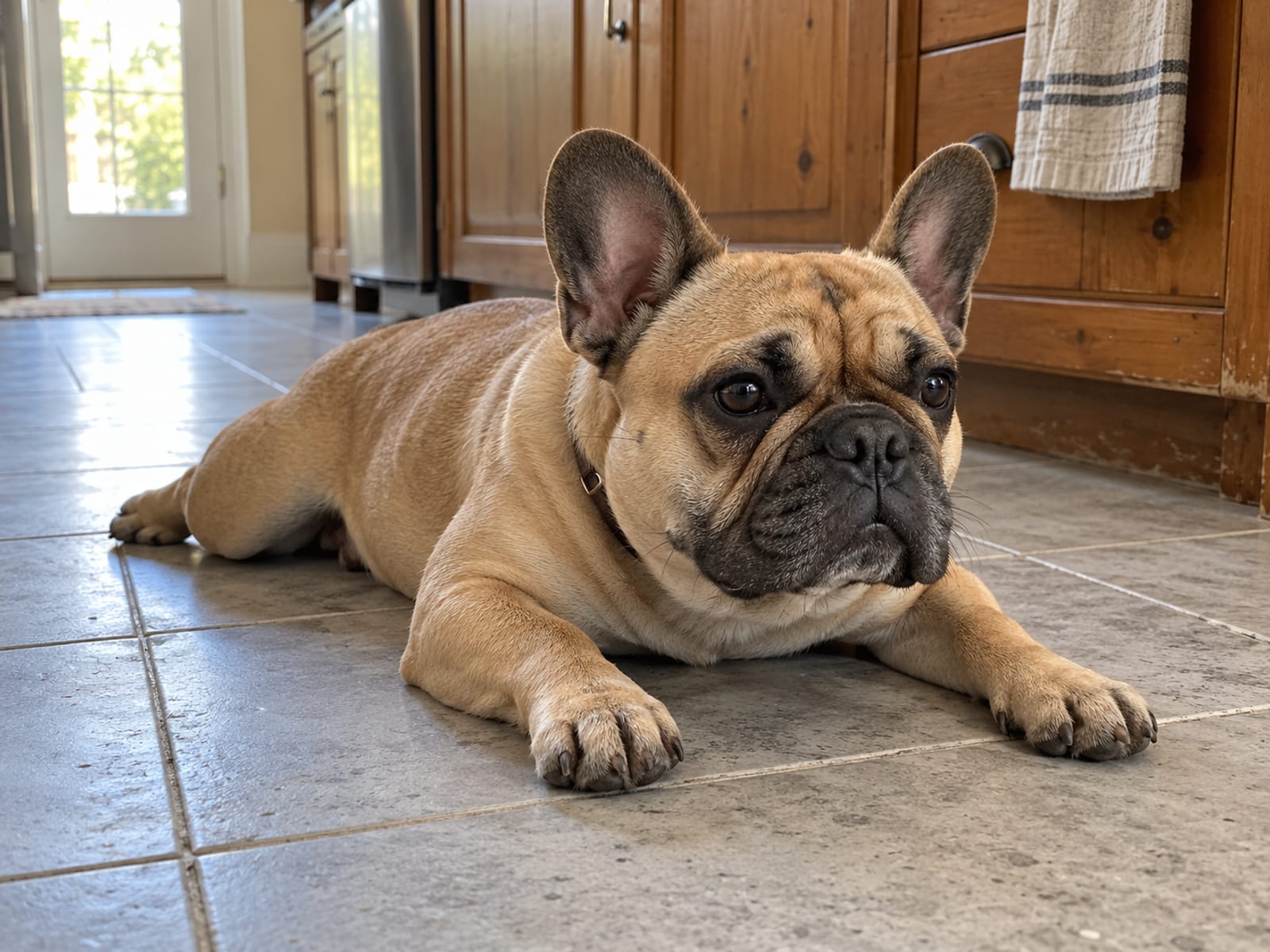
Adult size
Adults
- Weight
- up to 28 lb (12.7 kg)
- Height
- 11 to 13 in (28 to 33 cm)
- Size group
- Medium
Source: AKC French Bulldog standard (effective June 5, 2018); AKC breed page. Puppy size guide
AKC ratings (1 to 5)
These are the American Kennel Club's ratings for the breed as a whole; each dog is an individual. Source: AKC breed page (2026-10-23).
Living with a French Bulldog usually means a compact, affectionate companion who fits apartment life and needs moderate daily activity, weekly brushing and regular fold, ear and nail care. The tradeoffs are real: limits in heat and breathing, possible skin, eye and spine problems, difficulty with long absences and veterinary costs that can run high.
Most adults stand 11 to 13 inches tall and stay under 28 pounds, according to the AKC breed page. That small frame is part of the appeal, but the day-to-day details below matter more than size when you are deciding.
What a normal day looks like
The French Bulldog began as a companion and lap dog, and the French Bull Dog Club of America traces the breed to smaller Bulldogs kept by Nottingham lace workers and later developed in Paris. That history shows up at home. Expect a dog that wants to be near you, plays in short bursts and then settles.
A typical day is a few short walks, some sniffing, a little play and a brief training session. The rest is company, on the couch or at your feet. Every dog differs, but this is the pattern the breed tends toward.
How much exercise a French Bulldog needs
A practical adult target is about 30 to 60 minutes of low-to-moderate activity a day, split into short walks, sniffing, gentle play and brief training. The AKC says a short walk or outdoor play session each day should be enough to keep a French Bulldog in shape, and the UK charity PDSA gives up to an hour, divided into several shorter outings.
Mental work counts too. Food puzzles, basic obedience, trick training, scent games and gentle retrieving all fit. The AKC rates the breed 3 out of 5 for energy level and 3 out of 5 for mental stimulation needs, which matches a dog that wants some activity and some puzzles, but not a marathon.
The limit is heat. French Bulldogs are brachycephalic, meaning short-nosed, and their breathing and cooling can be restricted in hot or humid weather, when they are excited or during hard exercise. Skip strenuous play on warm days, never leave one unattended around water, and go easy on growing puppies because the breed also has spine and joint concerns. If you plan to fly, the AVMA's guidance on short-nosed dogs and air travel is worth reading first.
Grooming and shedding
The coat is short and smooth, so grooming is brief but recurring. Brush about once a week with a medium-bristle brush, a rubber grooming mitt or a hound glove. The coat does not need clipping or routine professional haircuts, though some owners use a groomer for baths or nail work.
The coat is the easy part. The recurring work is cleaning and drying the facial folds, checking and cleaning the ears, trimming nails and brushing teeth. The AKC's guide to whether the breed is right for you covers the routine.
The AKC rates Shedding Level 3 out of 5 and Coat Grooming Frequency 1 out of 5. French Bulldogs shed year-round, and some shed more as the seasons change. A short coat does not make a dog allergy-friendly; the American Academy of Allergy, Asthma and Immunology says no dog breed is truly hypoallergenic.
Temperament, training and time alone
The breed club describes French Bulldogs as "well behaved, adaptable, and comfortable companions with an affectionate nature and even disposition," and "generally active, alert, and playful, but not unduly boisterous." They can have big personalities and need adequate training.
You may hear that they are stubborn. The club says most strive to please their owners and respond to the right motivation, commonly food rewards. The AKC agrees that they can be stubborn but calls them people pleasers who train well with games and rewards, and it rates Trainability 4 out of 5.
Noise is rarely the issue. The club says they are generally not noisy, and the AKC gives Barking Level 1 out of 5, where 1 means "Only To Alert."
Time alone is the harder part. French Bulldogs are people-oriented, and PDSA says some develop separation anxiety and suggests not leaving them alone for more than four hours, with individual dogs varying a lot. Build absences up gradually and watch how your dog handles them.
Children, other pets, visitors and apartments
Many French Bulldogs fit apartment life. They are compact, adaptable and do not need a yard, and the breed club says they generally do well in small living quarters. The AKC rates Adaptability 5 out of 5, and it gives favorable ratings for young children (5 out of 5), other dogs (4 out of 5) and openness to strangers (5 out of 5). Those are AKC's breed-wide ratings, not a promise about your dog.
Supervise children around any dog. Introduce other dogs, cats and visitors gradually, and base the pace on how your dog actually responds. The breed club notes that individual French Bulldogs differ in how well they get along with other animals, so judge cat compatibility dog by dog.
This breed tends not to suit a few households: people who want a running or hiking partner, homes that run hot or are poorly cooled, homes where the dog will be alone for long stretches, and owners who cannot budget for potentially substantial veterinary care.
Health: what to know before you choose
Short noses and compact bodies come with recurring health concerns. Breathing trouble from narrowed nostrils or a long soft palate (BOAS) and overheating are the best known. Others include skin allergies and inflamed skin folds, ear infections, eye problems such as corneal ulcers and cherry eye, spinal disc disease, malformed vertebrae, hip dysplasia and slipping kneecaps. Difficult birth (dystocia) is on the list too.
A 2021 VetCompass study found especially high relative risk for narrowed nostrils, BOAS, ear discharge, skin-fold dermatitis and difficult birth. In a 2025 German survey of 574 French Bulldogs, owners reported allergies or hypersensitivity in 52%, ear disease in 36% and narrowed nostrils in 35%. These are population patterns, not a diagnosis for any one dog.
Lifespan varies by dataset. The AKC lists 10 to 12 years, while a 2024 study in Scientific Reports of 11,821 French Bulldogs in the UK estimated a median of 9.8 years.
The breed club's health testing page lists the screenings it requires for a CHIC number:
- A hip evaluation through OFA or PennHIP
- A CAER eye exam by a veterinary ophthalmologist
- A patellar luxation evaluation
- A cardiac evaluation
The club also recommends further screening, including respiratory function grading, tracheal hypoplasia, elbow dysplasia and cystinuria. A CHIC number shows the tests were completed and made public; it does not mean every result was normal.
What a French Bulldog costs
Public price guides updated in 2024 and 2025 put French Bulldog puppies at roughly $1,500 to $5,500, and individual breeders publicly list companion puppies at about $3,250 to $5,000 (see this price guide). A high price does not by itself mean good breeding or health.
Adoption costs less. The French Bulldog Rescue Network lists fees of $900 for healthy dogs under 2 years, $550 for healthy dogs from 2 to 8 years, and $400 for dogs over 8 or with special needs.
For yearly care, Rover's March 2024 French Bulldog guide estimated roughly $2,831 to $8,342, covering food, grooming and veterinary costs. A national estimate for dogs in general is about $1,400 a year in basic expenses, and a French Bulldog can run well above that because of breed-linked veterinary risks. Get local quotes for food, grooming, insurance and veterinary care before you adopt.
Questions to ask a breeder, rescue or foster
Before you commit, ask for the sire's and dam's registered names or OFA links, then look up the results in the OFA database. Ask for copies of the hip, eye, patella and cardiac records, plus any breathing, spine, trachea, elbow, cataract or cystinuria testing.
Ask how the parents breathe at rest and in warm weather, and how the puppies were delivered. With a rescue or foster, ask about the dog's history, any known medical needs, how it behaves when left alone and how it reacts to children, other dogs and cats.
Where to go next
The French Bulldog Rescue Network has regional contacts across the United States and Canada, and the AKC's rescue directory lists more groups. Local shelters and foster-based rescues are other routes.
To see how a French Bulldog compares with other small dogs, read our list of 10 small dog breeds or 9 apartment dog breeds. If grooming time is your main concern, the 10 low-maintenance dog breeds list is a good next stop. You can also try our puppy size predictor or browse the full dog breeds hub.