

Breed profile
German Shorthaired Pointer
An affectionate, athletic hunting dog that needs real exercise, real mental work and a lot of your company.
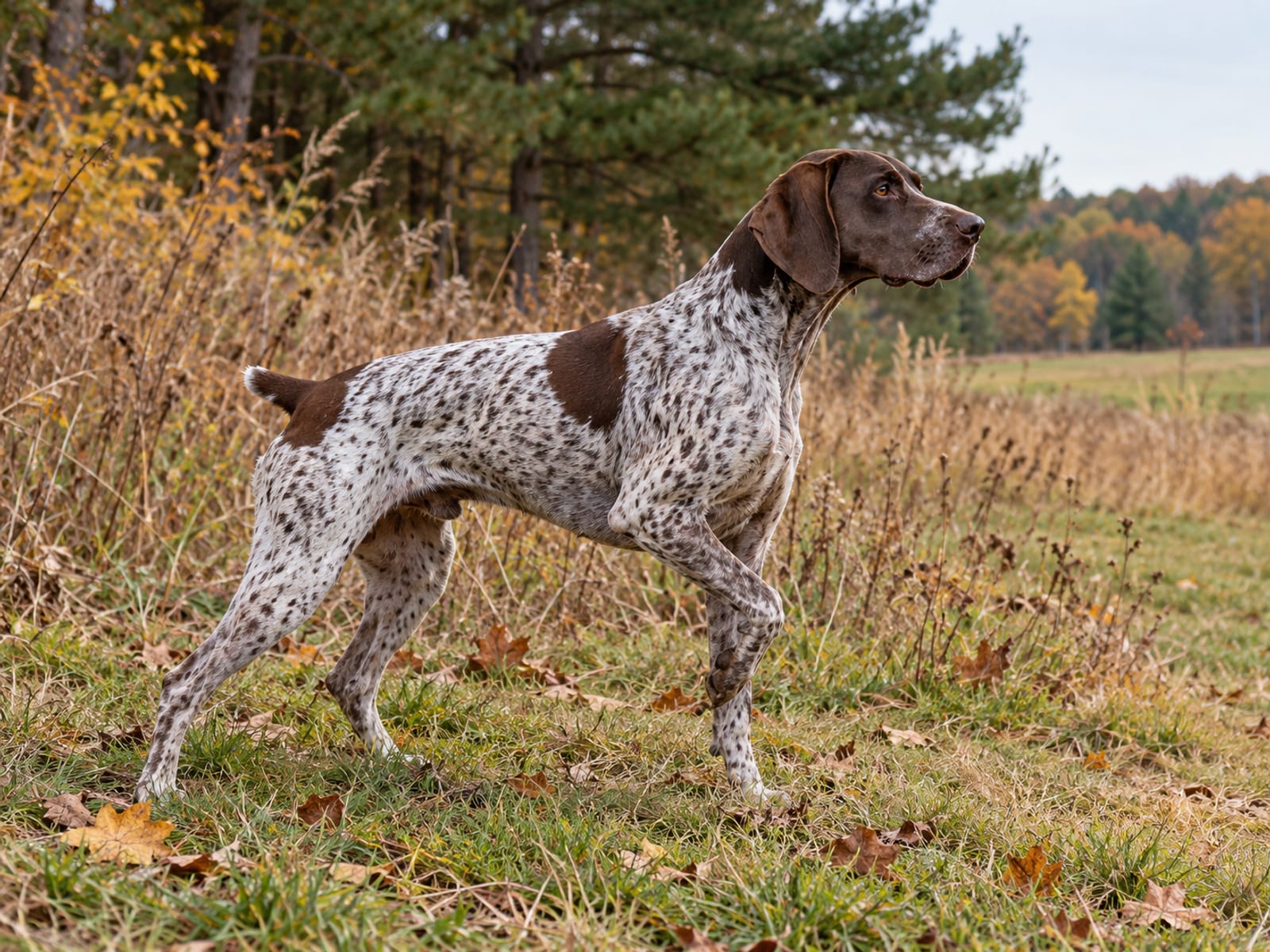
Adult size
Males
- Weight
- 55 to 70 lb (24.9 to 31.8 kg)
- Height
- 23 to 25 in (58 to 64 cm)
- Size group
- Large
Females
- Weight
- 45 to 60 lb (20.4 to 27.2 kg)
- Height
- 21 to 23 in (53 to 58 cm)
- Size group
- Medium
Source: AKC breed page. Puppy size guide
AKC ratings (1 to 5)
These are the American Kennel Club's ratings for the breed as a whole; each dog is an individual. Source: AKC breed page (2026-10-23).
Living with a German Shorthaired Pointer means sharing your days with an affectionate, athletic hunting dog that needs real exercise, real mental work and a lot of your company. The short coat is easy to keep up. The energy, the prey drive and a lively adolescence are what shape daily life.
This breed suits active households better than homes looking for a quiet, low-maintenance companion. Males stand 23 to 25 inches and weigh 55 to 70 pounds; females run 21 to 23 inches and 45 to 60 pounds, according to the AKC breed standard.
What follows covers the routine, the care, the health questions and the costs, so you can decide whether one fits your home. Everything here describes the breed's tendencies. Individual dogs vary.
What a typical day looks like
The German Shorthaired Pointer, often shortened to GSP, comes from Germany, where it was developed as a versatile hunting dog that could search, point, track and retrieve on land and in water. The AKC places it in the Sporting Group.
That background explains the dog you meet at home. Expect a morning and an evening built around activity, a dog that wants to be wherever you are, and a mind that goes looking for a job if you do not give it one.
How much exercise and mental work it needs
The AKC recommends ample physical activity twice a day, and its examples include brisk half-hour walks morning and evening, running, swimming, play in a secure fenced area, field activities, agility, obedience and dock diving. A practical baseline for an adult is at least 60 minutes of purposeful activity a day, split into two sessions. Many dogs need more, depending on age, health, breeding and behavior.
A short leash walk on its own is unlikely to be enough. Mix running or swimming with retrieving, scent games, obedience work or puzzle feeders. The AKC rates the breed 5 out of 5 for energy level and 5 out of 5 for mental stimulation needs.
Puppies need activity suited to their age and should not be pushed into repetitive high-impact running or jumping while they grow. Because the breed can be affected by bloat, the AKC advises skipping vigorous exercise right after meals and waiting at least an hour after eating and drinking.
Grooming and shedding
Grooming is the easy part. The coat is short, thick and a little rough to the touch, and it does not need clipping or hand-stripping. A brush or grooming glove every few days handles most of it, with more frequent passes during heavier shedding periods.
Add occasional baths with a gentle dog shampoo, regular nail trims, and an ear check, especially after swimming or field work. Brushing takes a few minutes. Baths, drying, nails and ears take longer and depend on how cooperative your dog is.
The coat is easy to maintain but it does shed, and short hairs can work into fabric and carpet. The AKC rates shedding 3 out of 5. No dog breed is truly allergy-free, as the American Academy of Allergy, Asthma & Immunology states, so this is not a breed to choose for allergies.
Temperament, training and time alone
The German Shorthaired Pointer Club of America describes the breed as "friendly, intelligent, willing to please," with "keen enthusiasm for work." Its buyer guidance says GSPs learn quickly and work hard for positive reinforcement, and that they can get creative when they lack focus. The AKC rates trainability 5 out of 5.
The harder stretch tends to come between about 6 months and 3 years. The AKC notes that a dog with too little activity or direction may turn destructive during that time, and the breed club warns that an unsupervised GSP can make "a big unexpected mess."
Barking varies by dog. The AKC rates it 3 out of 5, a middle range, and a bored or under-exercised dog may be louder. These are social dogs that bond closely with their families. Build up time alone gradually, with exercise beforehand, safe confinement and something to do, and do not assume your dog will be comfortable with long stretches alone.
Who this breed fits, and who it does not
GSPs can be affectionate, social and playful at home. The AKC says they may be too rambunctious for young children because of their size and energy, and recommends supervision. The breed club says GSPs generally have a good reputation with children, and stresses socialization, individual temperament and supervision. A big, enthusiastic dog can knock over a toddler without meaning to.
Many are social with other dogs, though introductions should be supervised. The breed club says GSPs may be "cat sharp" unless raised with cats, so do not assume cats or other small animals are safe. Most are outgoing with familiar people; how a dog greets visitors depends on its genetics, socialization and experience.
Apartment life works for some individuals, as long as you reliably supply substantial exercise, training, enrichment and access to safe outdoor space. The breed is a poor fit for a household that wants a low-activity dog, is away for long hours or cannot commit to daily outlets. The AKC's guidance on whether the breed is right for you is worth reading. For a first-time owner the breed is trainable but demanding, because of its energy, prey drive, exercise needs and challenging adolescent period.
Health: what to know and what to ask about
The AKC lists several breed-linked concerns: hip dysplasia and elbow dysplasia (joint development problems that can lead to pain and arthritis), progressive retinal atrophy and other eye conditions, cardiac disease, cone degeneration (an inherited retinal disease), and bloat, in which the stomach expands and can twist, which is a life-threatening emergency. Pet insurance claim data from Trupanion and the Veterinary Referral Center also shows swallowed foreign material and limping as more frequent puppy claims for this breed. These are risks, not diagnoses, and they do not predict what any one dog will develop.
For lifespan, the AKC lists 10 to 12 years. A 2024 study in Scientific Reports of dogs in the United Kingdom reported a median of 13.4 years for the breed, which describes a population and not an individual dog.
The AKC and the breed club recommend these screenings for breeding dogs: hip evaluation through OFA or an equivalent such as PennHIP, elbow evaluation through OFA, a cardiac exam by a veterinary cardiologist, an ophthalmologist's eye exam, and a cone degeneration DNA test. The breed club's health statement calls for cardiac, hip and elbow testing at 24 months or older, and annual eye exams through age 6. Screening lowers risk but does not guarantee a healthy puppy.
What a German Shorthaired Pointer costs
Breeder prices vary with region, pedigree, health testing, training and intended work. Advertised prices in 2026 included $1,500 from a Carolina breeder, $2,500 from an Alaska breeder and $2,700 from a Minnesota breeder. That suggests a range of roughly $1,500 to $2,700, but it is a sample of listings and not a national price.
Adoption costs less. Wisconsin German Shorthaired Pointer Rescue lists fees by age: $450 for a puppy under 1 year, $400 for ages 1 to 3, $375 for ages 4 to 7, $250 for ages 8 to 10, and $200 for dogs over 10. Its fees include vaccinations, heartworm testing and prevention, spay or neuter, microchipping, flea and tick prevention and a veterinary inspection. Other rescues set their own fees.
For yearly care, general dog averages from the American Pet Products Association put food at $293 and veterinary care at $331. AAHA reports accident-and-illness insurance averaging about $62.44 a month, or roughly $749 a year. Basic professional grooming for a short-coated dog is commonly estimated at $50 to $200 a year. Together that comes to about $1,423 to $1,573 a year, before training, boarding, dog walking, preventive medications, supplies, dental care, emergencies and regional price differences.
Questions to ask a breeder, rescue or foster
Whichever route you take, bring questions about the dog in front of you. These cover most of what matters:
- What are the registered names of both parents, and can I see the OFA results for hips, elbows and heart, plus the eye exam and cone degeneration DNA results?
- Who performed each exam, and on what dates? A CHIC number shows the required tests were done and recorded publicly, but OFA says it does not mean every result was normal.
- How has this dog or litter done around children, other dogs, cats and visitors?
- How much daily activity does this dog get now, and how does it handle time alone?
- For an adult from a rescue or foster, what is known about its history, training and any behavior concerns?
A good breeder, rescue or foster will answer plainly, and will tell you if your home is the wrong match.
Where to go next
The German Shorthaired Pointer Club of America keeps a national rescue page that lists regional GSP rescues across the country. Municipal shelters, county animal control and general rescues also have purebred and mixed dogs, and a shelter dog can be hard to identify by looks alone, so ask about behavior and history rather than relying on breed labels.
To see how big a puppy is likely to get, try our puppy size predictor. To compare other breeds, head to the dog breeds hub.
This breed also shows up in our lists of 7 active dog breeds and 10 smartest dog breeds, if you want to see how it stacks up against other dogs with a lot of drive.