

Breed profile
Rottweiler
A large, powerful working dog, affectionate with its own household and reserved with strangers.
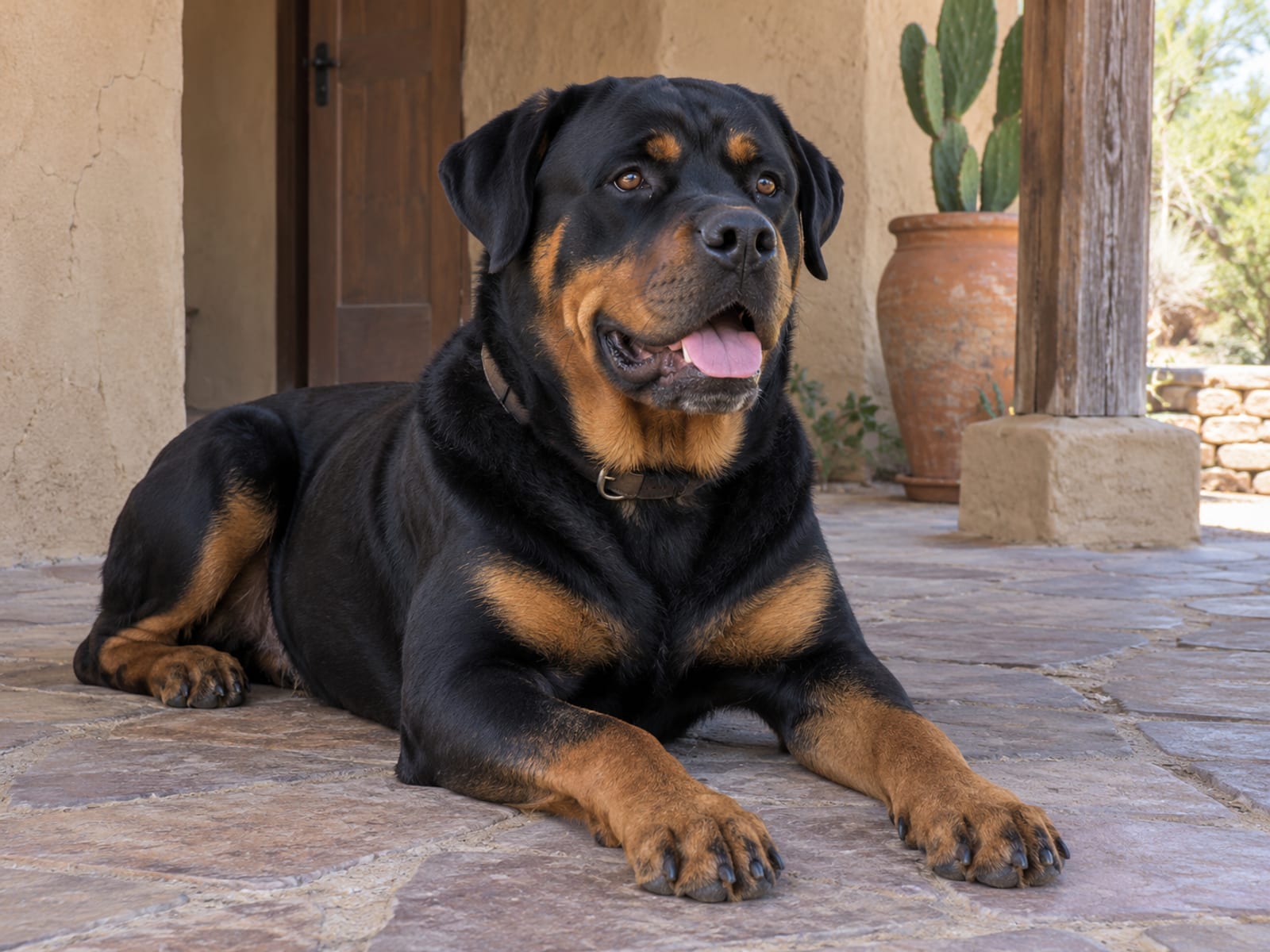
Adult size
Males
- Weight
- 95 to 135 lb (43.1 to 61.2 kg)
- Height
- 24 to 27 in (61 to 69 cm)
- Size group
- Giant
Females
- Weight
- 80 to 100 lb (36.3 to 45.4 kg)
- Height
- 22 to 25 in (56 to 64 cm)
- Size group
- Large
Source: AKC breed page. Puppy size guide
AKC ratings (1 to 5)
These are the American Kennel Club's ratings for the breed as a whole; each dog is an individual. Source: AKC breed page (2026-10-23).
A Rottweiler is a large, powerful working dog that is usually affectionate with its own household and reserved with strangers. Living with one means daily exercise, steady training, mental work and close attention around children, visitors and other animals.
The breed tends to suit an experienced, engaged owner who welcomes that responsibility. Individual dogs vary, so read what follows as tendencies rather than promises.
The American Rottweiler Club and the AKC breed page are good places to read more as you decide.
What a normal day with a Rottweiler looks like
The AKC places the Rottweiler in the Working Group. The breed developed around Rottweil, Germany, from dogs that drove and guarded cattle, protected their handlers and pulled carts, and the FCI breed standard still lists companion, service and working dog as current uses.
That history shows up at home. Expect a dog that wants a job, wants to be near you and notices everything that happens at the door. Adults commonly weigh 80 to 135 pounds, so even ordinary moments, like a greeting or a turn on a leash, involve real strength.
How much exercise and mental work it needs
For many healthy adults, a practical plan is about 60 to 120 minutes a day of movement and purposeful activity combined, adjusted for age, health, weather and the individual dog. AKC does not publish a fixed number, so treat this as a starting range and watch your own dog.
Good fits include brisk walks, hiking, swimming, trotting, retrieving, tracking, obedience, carting and other dog sports. The American Rottweiler Club says both puppies and adults need socialization, exercise and stimulating mental challenges, and AKC rates the breed 5 out of 5 for mental stimulation needs.
Puppies are different. Growing dogs need controlled activity and a large-breed growth diet, not forced endurance work, and repetitive high-impact exercise is best avoided while joints are still developing. Keeping body weight in check through life protects those joints. The VCA breed profile covers this kind of care.
Grooming and shedding: what it costs in time
Grooming is the easy part. The coat is short, coarse and dense, and it usually needs no routine professional clipping. A weekly brushing, a bath when the dog needs one, weekly teeth brushing (or as your vet advises), regular ear checks and about weekly nail trims or grinding, as AKC recommends, make up the routine.
A full session can take roughly 10 to 20 minutes at home. Shedding is moderate most of the year and heavier twice a year, usually spring and fall, so add brushing then and expect more hair on floors and furniture. AKC rates shedding 3 out of 5 and grooming frequency 1 out of 5.
A Rottweiler is not allergy-free. The AAAAI notes that no dog breed is truly hypoallergenic, since allergens come mainly from proteins in dander, saliva and urine rather than hair length.
Temperament and training
The breed standard describes the Rottweiler as "calm, confident and courageous," with "a self-assured aloofness" toward unfamiliar people and an inherent desire to protect home and family. The American Rottweiler Club says individuals range from affectionate natural clowns to reserved one-person dogs, and that early, continuing training is necessary because of the breed's size and strength.
AKC calls the breed intelligent, highly trainable and willing to please, and rates trainability 5 out of 5, while noting that some individuals can be stubborn. Barking is usually situational, tied to alerting or guarding, rather than constant, though dogs differ.
Rottweilers are "people dogs," in AKC's words, and do not do well isolated from humans and life experiences. Plan for regular company, enrichment and gradual practice at being alone. No fixed limit on time alone applies to every dog, so build it up slowly and watch how yours copes.
Fit with children, other pets, visitors and apartments
Rottweilers can live happily with children, but size, strength, a herding background and protective instincts call for active supervision and respectful child-dog interactions. AKC warns that a Rottweiler may accidentally knock over a small child or an older person. No breed guarantees safe behavior with every child.
Getting along with other dogs, cats and visitors depends heavily on the individual dog, early socialization, management and careful introductions. Because the breed is aloof with strangers, introduce guests deliberately rather than expecting an instant friendly greeting.
Some Rottweilers do manage in apartments when they get enough exercise, training, space and calm management. A yard helps, but it does not replace daily activity or time with you. The breed tends not to suit a household that wants a low-maintenance dog, cannot control an 80 to 135-pound adult, lacks time for training, or expects the dog to spend long stretches alone. AKC's own guide, Is the Rottweiler the Right Breed for Your Lifestyle?, goes through this in more detail.
The American Rottweiler Club's page on owning a Rottweiler says the breed's size, protective instincts and need for consistent training make experienced guidance valuable, so a first-time owner usually has an easier start with a mentor.
Health: conditions to know about and screenings to ask for
The American Rottweiler Club's health guide names hip and elbow dysplasia, which are joint problems that can cause pain and arthritis, and several cancers, including osteosarcoma, hemangiosarcoma and lymphoma. It also lists cataracts, eyelid problems, a heart condition called subaortic stenosis, and inherited nerve and muscle disorders such as juvenile laryngeal paralysis and polyneuropathy. Epilepsy and protein-losing enteropathy, an intestinal disease, are on the list too.
UK veterinary records from 2013, summarized by the Royal Veterinary College, also point to overweight, ear infections, osteoarthritis and diarrhea among the most often recorded problems. These describe the breed as a population and say nothing about any single dog.
On lifespan, AKC lists 9 to 10 years. A 2024 UK study in Scientific Reports estimated a median of 10.6 years across 9,717 Rottweilers, which is a UK figure and not a promise for any one dog.
For breeding dogs, the American Rottweiler Club's mandatory practices call for OFA hip and elbow evaluations after 24 months, an eye exam by a board-certified ophthalmologist, a heart evaluation, a DNA test for JLPP, and a CHIC number. A CHIC number shows the required tests were completed and published; OFA says it does not by itself mean every result is normal.
What a Rottweiler costs
Adoption fees vary by group, age, location and veterinary work. A 2026 compilation of US shelter and rescue fees reported about $400 to $600 for a puppy from breed rescue, $350 to $500 for an adult and $200 to $400 for a senior, with general shelters ranging from $25 to $600.
For a puppy from a breeder, ask each breeder for the current price and exactly what it includes, since prices differ widely.
For yearly care, a 2024 to 2025 American Pet Products Association survey, reported by the Insurance Information Institute, found average dog spending of $293 a year on food and $331 on total veterinary care. Those are averages for all dogs, so a Rottweiler's food, insurance, preventive care, training and emergencies can run higher. Price those items in your own area before you commit, and set money aside for emergencies.
Questions to ask a breeder, rescue or foster
A few questions make the decision clearer, whichever route you take:
- Can I see both parents' registered names or OFA links, plus the actual hip, elbow, eye, heart and JLPP results and the CHIC report?
- What do any abnormal or limited results mean for this litter?
- What is this dog's behavior history with children, other dogs, cats and visitors?
- What do the health records show, and what are the adoption terms and return policy?
- Who can I call for training advice after I bring the dog home?
Rescue groups should be judged one at a time on health records, behavior history, terms and where they place dogs.
Where to go next
The American Rottweiler Club's rescue and rehome page connects to the nonprofit Rottweiler Rescue Foundation, and the club also lists local Rottweiler clubs. The AKC Rescue Network is another route, along with shelters and owners rehoming through established rescues.
To see how this breed's adult size compares as a puppy grows, try our puppy size predictor. The dog breeds hub has more profiles, and the Rottweiler also appears in our lists of 10 guard dog breeds and 10 large dog breeds.